Law of Club and Fang
The Call of the WildLaw of Club and Fang is the governing principle of the Northland in The Call of the Wild: power belongs to whoever can impose it, survival depends on adapting to violence, and defeat can mean death. It first appears to Buck as the club wielded by the man in the red sweater, then expands into the fang-driven hierarchy of sled dogs, and finally becomes a code Buck both masters and carries into the wolf world.
Definition and First Lesson
Law of Club and Fang names a brutal order in which authority is established through force rather than persuasion, and weakness is exposed to immediate destruction. Buck encounters its two instruments separately. The man in the red sweater teaches the law of the club by repeatedly smashing down Buck’s attempts to escape. The Northland dogs teach the law of the fang through sudden attacks, pack pressure, and the rule that a fallen animal may not rise again.
The club is Buck’s first revelation. After being confined, he launches himself at the man in the red sweater with one hundred and forty pounds of fury, but the club stops him in mid-air and throws him to the ground. He charges again and again—twelve times in all—and each charge ends with the same shock. Blood flows from his nose, mouth, and ears; his coat is flecked with bloody slaver; and a final blow leaves him dazed. When water and raw meat restore him, the lesson remains: he has been beaten, but he has not been broken.
Buck understands that he cannot defeat a man with a club. The weapon is therefore more than an instrument of punishment; it is a revelation of a new political and bodily order. It makes the man a lawgiver and master whose commands must be obeyed, although Buck need not flatter or love him. Other dogs confirm the pattern. Some fawn, wag their tails, and lick the man’s hand, while a dog that refuses both obedience and conciliation is killed in the struggle for mastery.
The Northland Social Order
Buck’s arrival on the Yea beach turns the principle into a complete environment. He is torn from civilization and placed among dogs and men who recognize neither peace nor safety. Every moment demands alertness because the only operative law is the law of club and fang. The rule is not presented as an abstract doctrine learned in comfort; it is a condition of camp life, work, food, punishment, and continued existence.
Curly’s death gives Buck the first full demonstration of the fang. Curly approaches a husky the size of a full-grown wolf in a friendly manner. The husky leaps, tears her face open from eye to jaw, and leaps away before she can answer. When Curly rushes again, the attacker knocks her from her feet. Thirty or forty huskies have already formed a silent circle, waiting for precisely that fall. They close in, and Curly is buried beneath their bodies. Francois and three men with clubs drive them off, but within two minutes Curly lies lifeless and almost torn to pieces in the trampled snow.
The scene teaches Buck that there is no fair play in the primordial order. Once an animal goes down, the contest is over, and the surrounding group converts defeat into collective killing. The memory returns to trouble Buck in sleep. It also fixes his hatred of Spitz, who watches the death with a gesture Buck interprets as laughter. The law thus creates not only fear but rivalry: Buck learns that survival requires refusing to be the one who falls.
Training, Labor, and Adaptation
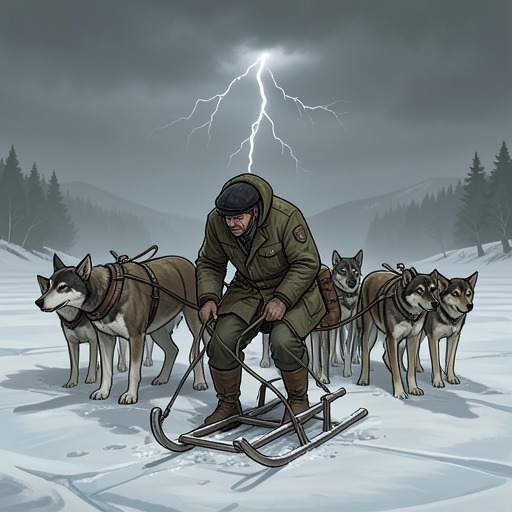
Law of Club and Fang governs labor as well as combat. Francois places Buck in a harness and makes him haul a sled to the forest and return with firewood. Dave and Solleks teach him through disciplined bites, while Spitz, the experienced leader, corrects him by growling or jerking the traces. Francois’s whip reinforces every lesson. Buck quickly learns to stop at “ho,” move at “mush,” swing wide around bends, and keep clear of the wheeler when a loaded sled rushes downhill.
The team’s structure makes hierarchy visible in bodily positions. Dave is the wheeler; Buck is placed ahead of him; Solleks follows Buck; and the remaining dogs stretch forward in single file toward Spitz, the leader. Buck is deliberately positioned between experienced dogs so that his body can be corrected from both sides. When he becomes tangled in the traces and delays departure, Dave and Solleks administer a beating severe enough to leave an even worse tangle, but Buck thereafter keeps the lines clear. Discipline becomes practical knowledge: obedience is not merely submission but the acquisition of skills needed to survive the trail.
The same order transforms the dogs’ relationship to work. Dave and Solleks, passive and unconcerned outside the harness, become alert, active, and fiercely irritated by delay once attached to the sled. The toil of the traces appears as the highest expression of their being. Buck, initially offended by being made a draught animal, discovers that the team’s eagerness enters him as well. The law therefore produces a functional solidarity even while it rests on coercion: the dogs pull together because disorder brings correction, exhaustion, and danger.
Hunger extends the law into the management of food. Buck receives a pound and a half of dried salmon each day yet remains perpetually hungry, while smaller dogs receive only a pound and stay in condition. His old fastidiousness disappears when other dogs steal his unfinished ration. He learns to eat as quickly as they do and then copies Pike’s theft, secretly taking an entire piece of bacon while Dub is punished for the crime. The act marks Buck’s adaptation to the Northland: private property and personal feeling, meaningful under the law of love and fellowship, become liabilities under Law of Club and Fang.
Buck does not steal because theft gives him pleasure. He steals because hunger makes it easier to steal than to go without food, and because secrecy avoids the club. His moral nature changes through necessity rather than deliberate argument. His muscles harden, ordinary pain loses its power, his senses sharpen, and he learns practical winter techniques such as biting ice from between his toes, breaking the crust over a water hole with his forelegs, and forecasting the wind so that his sleeping place remains sheltered. At the same time, ancestral fighting instincts return: the quick wolf snap and the slash-and-leap method seem to come to him without instruction.
Rivalry and Dominance
The law reaches its clearest canine expression in the conflict between Buck and Spitz. The dominant primordial beast grows stronger in Buck, but his growth is concealed by caution. He avoids rash attacks and waits, while Spitz repeatedly provokes him, recognizing him as a dangerous rival. Buck’s resistance begins indirectly. He interferes when Spitz tries to punish the shirker Pike, and when Pike is dug from a nest beneath a foot of snow, Buck places himself between the two dogs and throws Spitz backward.
Pike takes courage from the mutiny and attacks his fallen leader; Buck joins him. Francois beats Buck with the lash and whip handle, but cannot immediately drive him away. Thereafter Buck continues his interference when Francois is absent, and general insubordination spreads through the team. Dave and Solleks remain devoted to the work, but the other dogs grow quarrelsome and disorderly. Buck’s challenge is therefore political before it is physical: by interrupting Spitz’s punishments, he weakens the old leader’s authority and makes the team’s hierarchy unstable.
When the final fight comes, a silent circle of sixty dogs waits to devour whichever combatant falls. Buck is bleeding and tiring while Spitz uses repeated rushes to undermine his footing. Buck’s decisive advantage is imagination. He combines instinct with calculation, feints toward an old shoulder attack, then sweeps low and breaks Spitz’s left foreleg. He repeats the maneuver against the right foreleg. With both front legs broken, Spitz sees the circle closing around him, but Buck offers no mercy. The surrounding pack and the law itself confirm the result: a defeated rival has no protected middle position.
Buck’s final rush ends with shoulder meeting shoulder and Spitz disappearing into the dark circle. Buck remains standing as the successful champion, the dominant primordial beast who has made his kill. The victory is not simply revenge for Curly or the fulfillment of a personal hatred. It is Buck’s initiation into the authority that Law of Club and Fang recognizes. He has survived the club, learned the fang, and demonstrated that he can impose the law upon others.
Leadership and Limits
After Spitz disappears, Buck refuses to return to his former place. Francois tries to replace Solleks with him and then attempts to restore the old arrangement, but Buck repeatedly displaces Solleks. When Francois approaches with a heavy club, Buck remembers the man in the red sweater and retreats beyond its reach. This retreat is not surrender. Buck watches the club carefully, circles outside its range, and refuses to enter the traces until his demand is met.
For nearly an hour Francois and Perrault chase him and throw clubs, while Buck dodges without attempting to escape from camp. He is not seeking freedom from the team; he is demanding leadership. Once Francois complies, Buck trots into the head position, and the sled moves out. The episode clarifies the difference between fear and submission. Buck respects the club’s power, but he no longer accepts every command as legitimate. He has learned to calculate force, evade it, and use his own earned dominance to alter the hierarchy.
As leader, Buck proves superior even to Spitz in judgment, quick thinking, and action. His greatest ability is enforcing order. He repeatedly shakes Pike for loafing until Pike pulls harder than ever, and he subdues Joe, who had resisted Spitz’s discipline, until Joe stops snapping and begins to whine for mercy. The team immediately regains its solidarity and once again moves as though it were one dog. Buck’s leadership is therefore functional as well as violent: he uses the same law that made him dominant to restore coordinated labor.
The rule also exposes its human limits. Later, when Hal commands the exhausted dogs to pull an overloaded sled, they strain against the breastbands but cannot move it. Hal prepares to lash them, while Mercedes seizes the whip and demands that he stop being harsh. Her intervention does not erase the violence built into the work, but it briefly contests the assumption that a failed animal is simply a lazy one. Against that background, Buck’s earlier training shows how easily labor, discipline, and punishment can be treated as the same thing.
From Primitive Law to the Wild
Law of Club and Fang does not disappear when Buck enters John Thornton’s life. Love and fellowship become possible between Buck and John Thornton, and Buck will not steal from him, yet the older code remains active in Buck’s body and judgment. He still fights strange dogs with ruthless efficiency, and he treats an initiated struggle as one that must end in mastery or death. Skeet and Nig are safe because they belong to John Thornton and are too good-natured for quarrels, but unfamiliar dogs must acknowledge Buck’s supremacy or face a terrible antagonist.
Buck’s mercilessness is presented as learned experience and inherited memory. From Spitz and the chief fighting dogs of the police and mail teams, he has learned that there is no stable compromise in primordial life. Mercy is interpreted as weakness, and weakness invites death. The command is stark: “Kill or be killed, eat or be eaten.” Even beside John Thornton’s fire, Buck remains a creature brought in from the wild rather than a Southland dog fully marked by civilization.
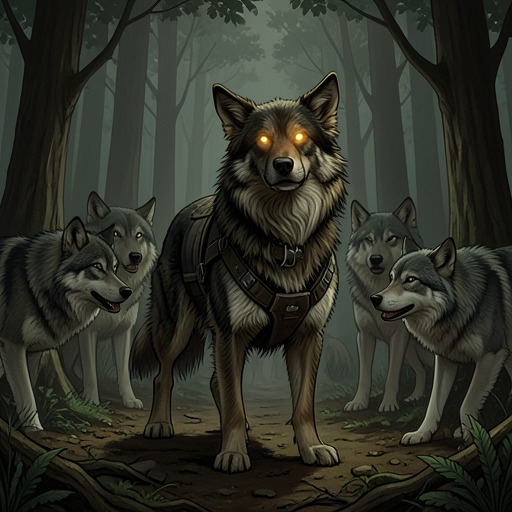
The law finally becomes the foundation of Buck’s place among wolves. After the Yeehats kill John Thornton, the last human tie is broken, and Buck answers the call of the approaching pack. When the wolves enter the clearing, Buck kills the first attacker by breaking its neck, wounds three others, and holds the pack at bay for half an hour from a position protected by a gravel bank. Only after the pack is discomfited does a gray wolf approach in friendship—the wild brother with whom Buck once ran—and touch noses with him.
An old, battle-scarred wolf then begins the long howl, the pack joins, and Buck answers. The scene retains the law’s violence but adds recognition and affiliation: dominance has become the condition through which Buck can enter the group, not merely destroy it. He runs away with the wolves, side by side with his wild brother. In the later Yeehat legend, the Ghost Dog leads the pack, steals from camps, robs traps, kills dogs, and defies hunters. Law of Club and Fang has therefore carried Buck from victimhood to mastery and, finally, into a wild social order where his authority is remembered as terror.